Welcome!

Thanks for checking out my website!

The site’s purpose is pretty simple:

There’s nothing I find more exciting — or believe more necessary — than working to increase the effectiveness of environmental messaging in order to engage the entire public on climate change.

OK, I know, it sounds crazy and maybe a bit foolish.

After all, “environmentalism” has never been as politically polarized as it is today. And at no other time has “belief in climate change” been more hotly contested or used as a litmus test for political party identification. And we haven’t even gotten to the countless messaging strategies, campaigns, and even celebrity appeals that have failed spectacularly to successfully motivate the general public to demand immediate action.

Look, I get it.

But that’s why I love it.

There’s an enormous problem of vast social importance that needs solving.

There’s a once-in-a-generation challenge that demands our immediate attention and efforts.

And there’s really no other way out of it — we either deal with climate change as a people or else.

And I’ve built this site to showcase my individual strengths, points of interest, and the value I’d bring to this effort.

If you like what you see, I’d love to talk with you. An award-winning campaign might be right around the corner.

Enjoy!

Dan Murphy
dmurphy135@gmail.com
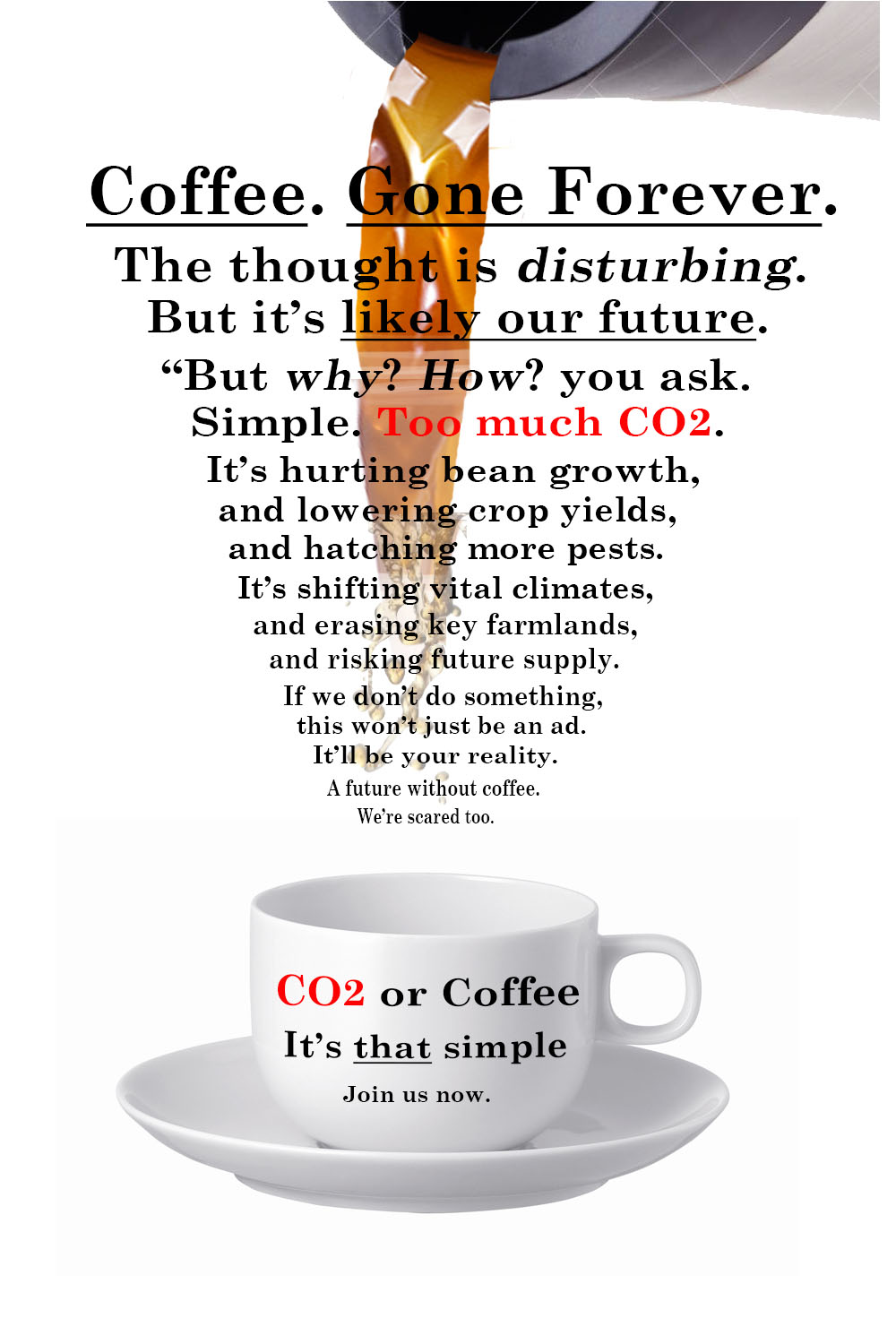
Your Coffee Is Disappearing

I created the following spec ad (don’t mind the shabby Photoshop work) after drawing on the following insight:

Which is why I picked coffee…

What could be more “close to home” and “personal” than something millions of people wake up with every morning?

Coffee Ad


Going Right For The Sweet Tooth

Likewise, here’s another spec ad that accounts for the same “local” insight, but also incorporates another research finding:

  • Environmental “information campaigns” can actually backfire, unintentionally increasing polarization among citizens, while also increasing the likelihood of climate denial and subsequent resistance on action (See: Hart & Nisbet, “Boomerang Effects in Science Communication

That’s why I’ve added a little twist to this ad, playing off the concept that some climate change ads are a little too “preachy”…

***

Print Ad – Climate Change Campaign

Photo

[A “s’more”, but without chocolate]

Header

A world without chocolate”

Body Copy
Get ready — it’s going to be your future. Rising temperatures are drying up cocoa trees and shrinking the abundance of cacao beans, the main ingredient in chocolate. This dehydration process, called evapotranspiration, describes…on second thought, do you really care? If you’re like us, just the thought of chocolate going extinct is enough to do something. Join us if you feel the same.
Learn more at [yourwebsite].com

Going Beyond “Green for Green’s Sake”

The term “environmentalist” has unfortunately taken on negative connotations. And that’s not just me saying that — you can read David Fenton’s Q&A on the current state of environmental communication here.

And that’s why I wanted to showcase something different with this spec ad. I wanted to take something that just screams “environment” — like a fictional 100% hemp clothing line — and communicate it to a broad, non-political audience.

***

Print Ad

Photo

Two runners jogging on the sand alongside a beach shore line. Bright clean sunshine radiates down. Crisp blue ocean water reflecting back.

One runner, drenched in sweat, leaves heavy footprints in the sand.

The other, a few steps ahead and sweat-free, has left no footprints behind him at all.

Header

“Never leave a footprint”

Sub Text

Thompson’s 100% hemp wear. Lighter. Sustainable. Footprint Free.

Imagine Life as a Polar Bear

I’m on many newsletter lists, including the Environmental Defense Fund’s list. I love EDF’s mission, and that’s why I love re-writing their e-mail campaigns.

An e-mail campaign is a great way to reach your audience, but you’ve got to grab attention immediately, hold it, and then convert that interest into action.

I’ve rewritten and restructured a recent EDF e-mail, trying to do just that…

***

Daniel,

Imagine life as a polar bear.

Imagine swimming in frigid arctic waters, crossing melting ice sheets drifting farther and farther apart, and watching your cubs barely staying afloat.

Imagine your hunting grounds shrinking with each ice thaw, pangs of hunger churning your stomach more and more, and your cubs suffering from starvation.

Imagine being shoved closer to extinction with each breathe you take, your entire world disappearing in front of you, and being unable to do anything about it.

Now stop imagining, and hear this.

Two out of three polar bears will be gone by 2050.

That’s right. Two out of three, vanquished from existence.

But now, imagine something different.

Imagine YOU could help end this awful reality for polar bears.

Imagine YOU could help change this tragically bleak future.

Imagine YOU could help create a more hospitable environment for these magnificent animals.

Well, Daniel, here’s the great news:

You HAVE THE CHANCE to do something RIGHT NOW.

Start your monthly gift of $15 or more today and help protect polar bears from their increasingly hostile environment.

Donate NOW and help create a more stable and viable climate for them and millions of other animals.

Make your pledge and your first 12 monthly gifts will be matched $1-for-$1 by the Robert W. Wilson Charitable Trust.

And as special thanks, start your gift before midnight tonight we’ll send you your choice of a polar bear plush animal or stainless steel water bottle!

Daniel,

We CAN do something to change this sad reality for polar bears.

But we NEED to START NOW.

Make your pledge TODAY.

Thank you for your kindness.

Be A Part of History in 2015

Here’s another example of an EDF e-mail campaign, re-written to call more attention to action, re-formatted to keep eyes moving, and retold to give the reader a sense of greater purpose than complying with an e-mail request. Plus, I think the “Rule of 3” works really well in this campaign.

***

Daniel —

We’ve made history!

Because of your efforts, the EPA will finally address METHANE POLLUTION, a gas 84X more potent than CO2, and responsible for 25% of all climate change.

This will help solve climate change in a manner that’s faster and cheaper.

Show your support! Send the EPA a note of thanks NOW!

But make no mistake — this fight is far from over.

We’re still NOT PROTECTED from EXISTING SOURCES of methane pollution — only new and future sources.

It’s wrong to let polluters damage our air without consequence.

It’s wrong to have no safety limits on this toxic gas.

It’s wrong to continue the hazardous status quo.

Tell the EPA to STRENGTHEN THEIR STANCE ON METHANE.

Tell the EPA that WE’VE HAD ENOUGH OF THIS TOXIC GAS.

Tell the EPA that WE CAN’T AFFORD TO WAIT ANY LONGER


Thank you for your courage in this fight.

And thank you for always standing with us.

Digging Into Research, Pulling Out Valuable Insights

There’s a wealth of research on advocacy marketing.

And that’s where I come in.

I’ll pour over Google Scholar so you don’t have to; I’ll read volumes of dense research so you won’t need to; and better yet, I’ll write summaries so you can quickly read it on your iPhone on your subway commute.

Here’s a sample.

***

“Promoting Pro-Environmental Action in Climate Change Deniers”
Paul G. Bain, Matthew J. Hornsey, Renata Bongiorno & Carla Jeffries

Summary:

Re-framing climate action as a means toward social betterment may be a more efficient strategy in gaining support from climate change deniers, as compared to framing action as a means to avoid catastrophe/disaster/climate change.

More:

  • Denier show greater intent to act when they believe climate policies will generate positive social benefits, such as making people more warm, considerate, and moral, or increasing economic & technological progress
  • This “Warmth/Development” frame may be even more effective among BOTH believers and deniers for encouraging action; according to this study, individuals are more willing to support action by almost 33% when messages highlighted positive results of climate policies, as compared to scientific/”avert-danger” frame

The Psychological Hurdles of Climate Change

Here’s another research summary, broken down for easy reading, sharing, and understanding.

***

“Climate Change and Moral Judgment”
Ezra M. Markowitz and Azim F. Shariff

Summary:

  • General public urgency for climate action unequal to magnitude of threat
  • Study suggests climate change is not seen as a moral imperative
  • Moral intuition triggers immediate action against wrongs, dangers
  • Major psychological challenges in perceiving climate change as a moral imperative, including following reasons:

1) Climate Change is Too Abstract, Too Complex

  • Clear and visceral concepts are needed to activate moral judgments
  • Climate change lacks these concepts
  • Instead, climate change activates our analytical reasoning, which is more passive and detached than our emotional reasoning

2) Blamelessness and Unintentional Actions

  • Moral imperatives crave a perpetrator: “Who’s to Blame?”
  • Climate change fails to answer this moral craving when perceived as unintentional side effect of industrial living.
  • Moral action decreases when no one’s to blame as unintentional harms are judged lighter than intentional ones

3) Assigning Guilt Can Be Self-Defeating

  • Individuals instinctively defend themselves at all costs when blamed for moral transgressions
  • This “Guilty Bias” can lead individuals to deny their role in the problem, question evidence, and even deny the very existence of the problem, leading worst offenders to resist the most

4) Uncertainty Breeds Wishful Thinking

  • People are naturally optimistic in the face of uncertainty
  • Therefore unrealistic and optimistic thoughts can exist when uncertainty is present, suppressing smart, meaningful, urgent action

5) Moral Tribalism

  • Liberals and conservatives differ on moral perceptions
  • Liberal-leaning moral focus dominates climate advocacy
  • Therefore, conservatives have less moral justification for action, and this framing has polarized climate change, unintentionally activating in-group/out-group thinking

6) Long Time Horizons, Far Away Places

  • Climate change seen as harming individuals different than ourselves (poorer, different social, economic, and cultural systems)
  • This perspective can turn the perceived victims of climate change into “out-group” members
  • Recent research suggests that the more dissimilar or distant the victims, the less morally obligated people feel towards them

Analyzing Homeless Polar Bears

Research, however, is worthless if you don’t apply it to your campaign strategies. Here’s a spec analysis of a recent climate change ad, with a focus on applying insights from recent findings.

***

Ad Title: “You can help. Stop global warming.”

WWF-03

Overall Message?
Compel action by invoking emotions of sympathy and moral concern by highlighting the dire, unjustified, and desolate circumstances our actions (and subsequent inaction) will create for polar bears. We are — quite literally —tossing them out into the streets.

What research can we draw upon?

  • Ad is focused heavily on “Care/Harm” moral foundations (as per MFT). This strategy of awareness not only fails to communicate “conservative-leaning” moral concerns necessary to ignite the moral/political willpower of nearly half the country, but also may increase the political divide on the issue. (See “The Moral Roots of Environmental Attitudes, Feinberg & Willer, 2012)
  • The use of a polar bear as the victim may increase the likelihood that a “Boomerang Effect” will occur among conservative/Republican viewers, as a non-human species whose habitat is quite literally the North Pole would adequately count as a “high social distance” victim. (See Boomerang Effects in Science Communication, Hart & Nisbet, 2011)
  • It might be safe to assume no one purposely leaves their lights on to intentionally ruin the habitat of a cute, cold-climate animal. Therefore, the psychological flaw of “Blamelessness of Unintentional Action” could also be said to be present within this messaging campaign. (See Climate Change and Moral Judgment, Markowitz & Shariff, 2012)

What improvements can be made to expand messaging reach?

  • Include “conservative-leaning” moral concerns, such as “disgust sensitivity” to increase the likelihood climate action will be seen as a moral imperative by more than just environmental advocates and liberal-leaning audiences  (See Climate Change and Moral Judgment, Markowitz & Shariff, 2012)
  • Instead of framing action as a way to avoid the negative consequences of climate change, frame climate action as a means towards social betterment. When individuals perceive climate action as a way to improve their communities, societies, and surround worlds, they’re more willing to act as environmental citizens — regardless of existing belief in climate change. (See Promoting Pro-Environmental Action in Climate Change Deniers, Bain, Hornsey, Bongiorno, & Jeffries, 2011)